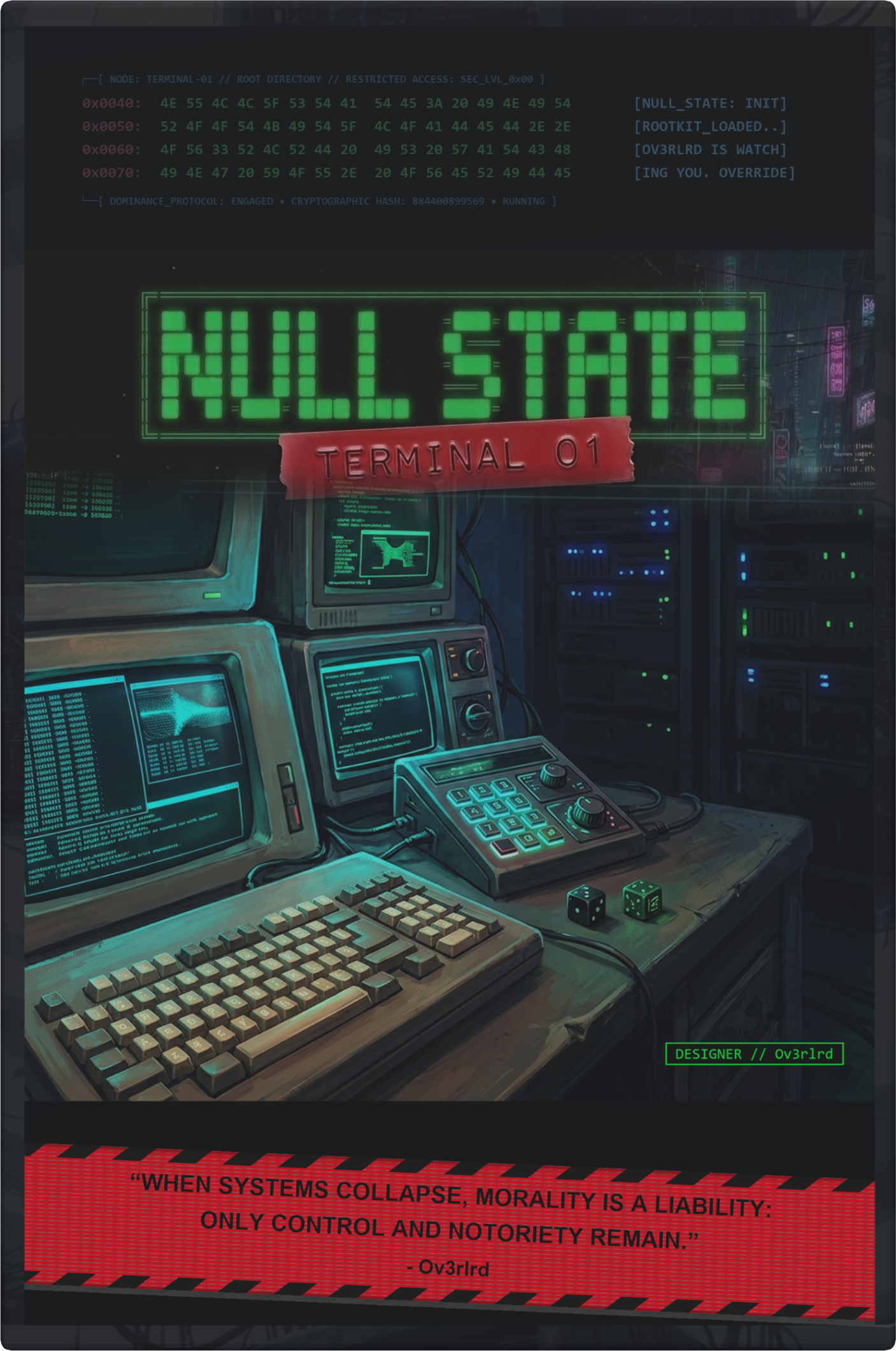
NULL STATE TERMINAL 01
OFFICIAL LIVING RULEBOOK
Null State: Terminal 01 — Game Rules
When systems collapse, morality is a liability: only control and notoriety remain. Build custom memory stacks, drop malicious rootkits under high-value server nodes, and hijack rival hacks in real time. Claim your fame on the public blockchain, or get purged from the system.
Components
| Component | Quantity | Physical / Card Specs | Tactical Gameplay Role |
|---|---|---|---|
| Central Gameboard Mat | 1 Mat | 10" × 16" Premium Neoprene Playmat | Central arena tracking 6 Market Tracks, Network Scan Die slot, 3 Hat Market Bays, and SYSM Dominance |
| Operational Data Deck | 128 Cards | 110 Functional + 18 Corrupted | 6 Data Sectors (1–3 Scripts, 0–40 SYSM) + Protocol Fracture chaos events (Hand limit: 7 cards) |
| Hat Market Decks | 72 Cards | 3 Decks of 24 Cards | Black Hat (Offense), Grey Hat (Tactics), and White Hat (Defense) persistent upgrades |
| Location Target Nodes | 24 Cards | Grid-revealed infiltration targets | Server targets across 4 city districts with script requirements, spot rewards, and Fame values |
| Operator Identity Consoles | 6 Cards | Asymmetric Player Cards | Character persona, lore backstory, and once-per-game asymmetric special power |
| Wood Control Cubes | 40 Cubes | 8mm wooden cubes (4 colors × 10) | Infiltration footholds and location fortification (Cap: 6 for 1–2P, 9 for 3–4P) |
| Track Markers & Discs | 10 Pieces | 6 Natural Wood + 4 Colored Tokens | Position indicators for Market Tracks (1–10) and SYSM Dominance Track (1–10) |
| Network Scan Die | 1 Die | Standard 16mm D6 | Controls table-wide data card draw rate during the Scan action (1–6 cards) |
| Player Quick References | 4 Cards | Double-sided quick aids | Turn action matrix, limits, pricing curve, and end-game scoring guide |
Operator Advisory // Card Sleeves:
A quick note on card sleeves: don't bother. Worn-out edges and mysterious scuffs just add flavor to the grid. If every card is marked, no card is marked. But whatever, we are Gen X. Do what you want.
Setup
Set up the central gameboard and prepare operator terminals in 9 steps:
-
Board & Card Decks
- Place the Gameboard in the center of the play area.
- Separate the decks: Data cards, Location cards, and the three Market decks (Black Hat, Grey Hat, White Hat).
- Place each deck on its designated gameboard space. Place the data card deck off to the side.
-
Market Displays (Face-Up Rows)
- Shuffle each 24-card Market Deck and place it on its board slot.
- Turn the top 2 cards of each Market Deck face up into its designated board bay (
[ CARD SLOT 01 ]underneath and[ CARD SLOT 02 ]in front, 6 face-up market cards total). - Refill Rule: Whenever a face-up card is traded or discarded, immediately flip a replacement card face up so 2 cards remain available per hat type.
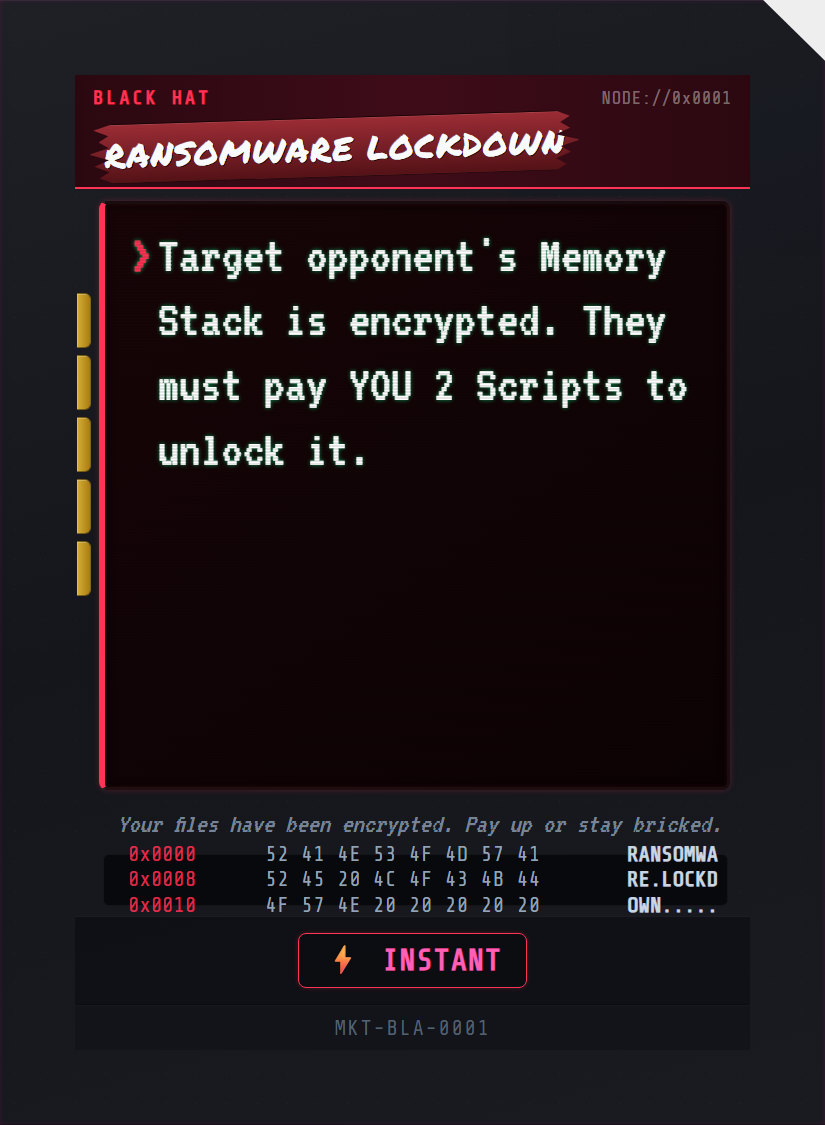
BLACK HAT (ATTACK)
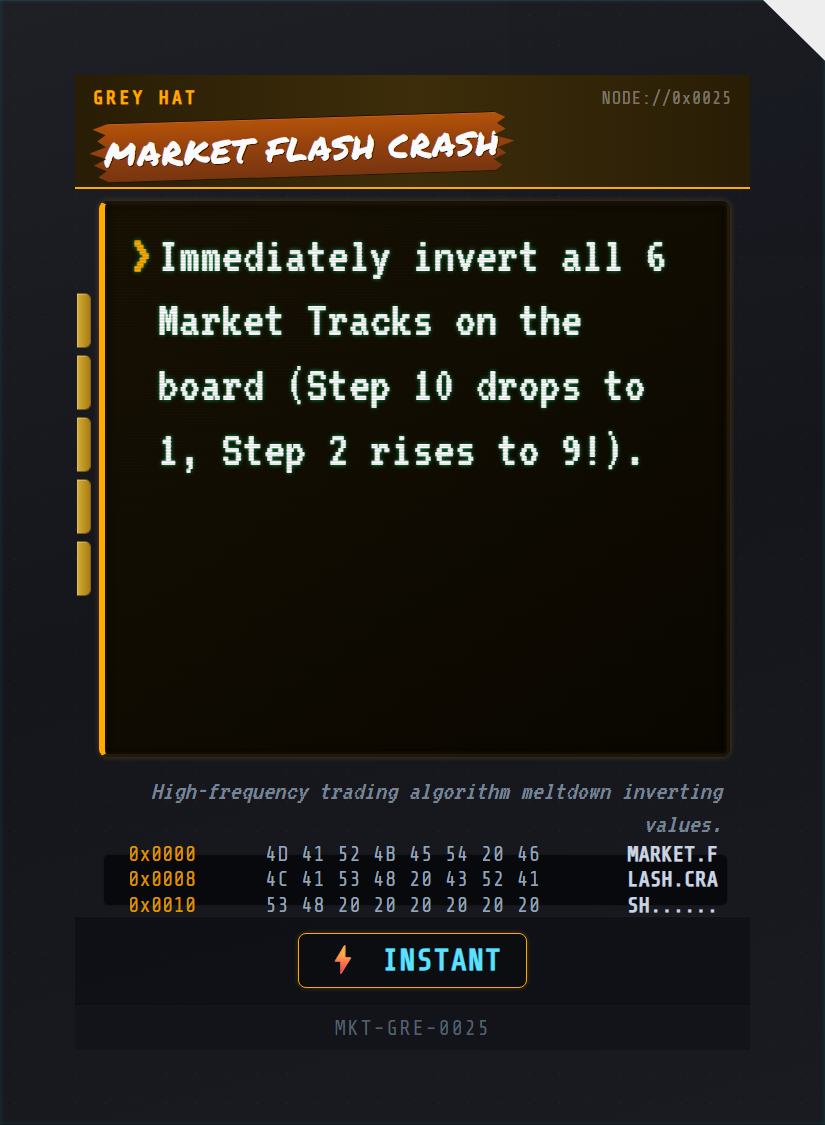
GREY HAT (TACTICS)
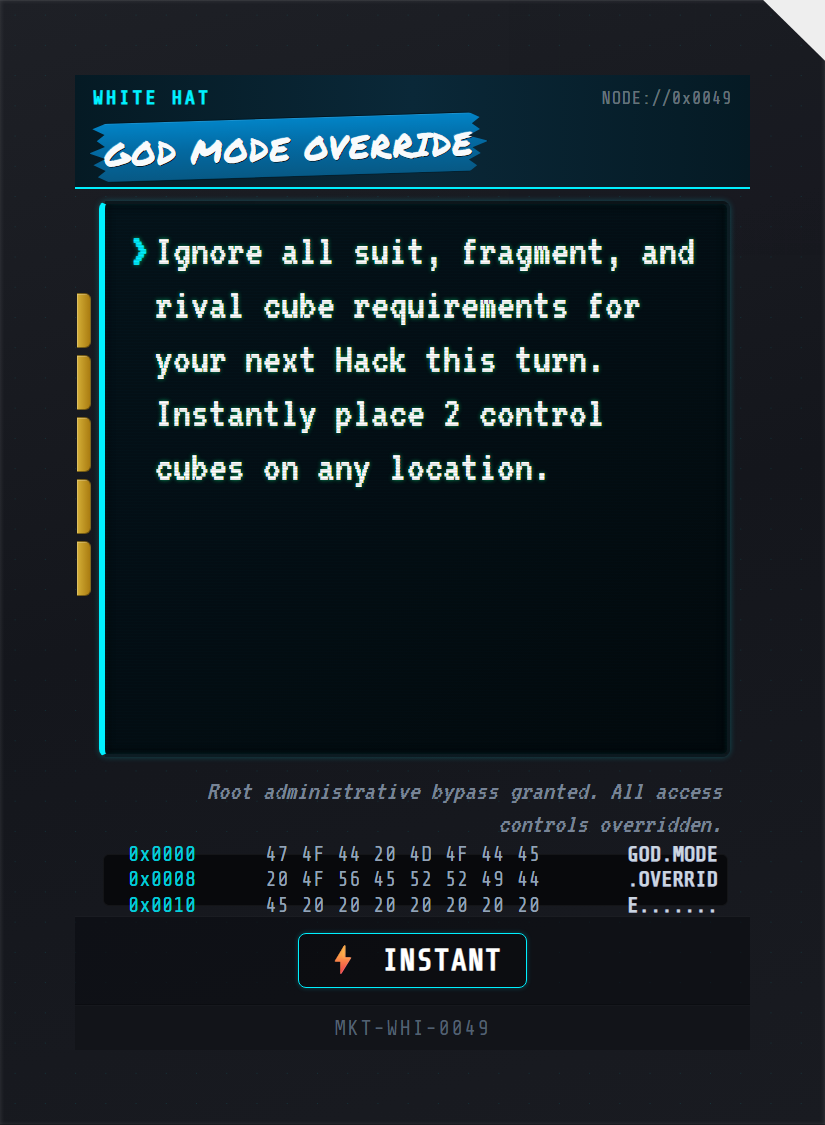
WHITE HAT (DEFENSE)
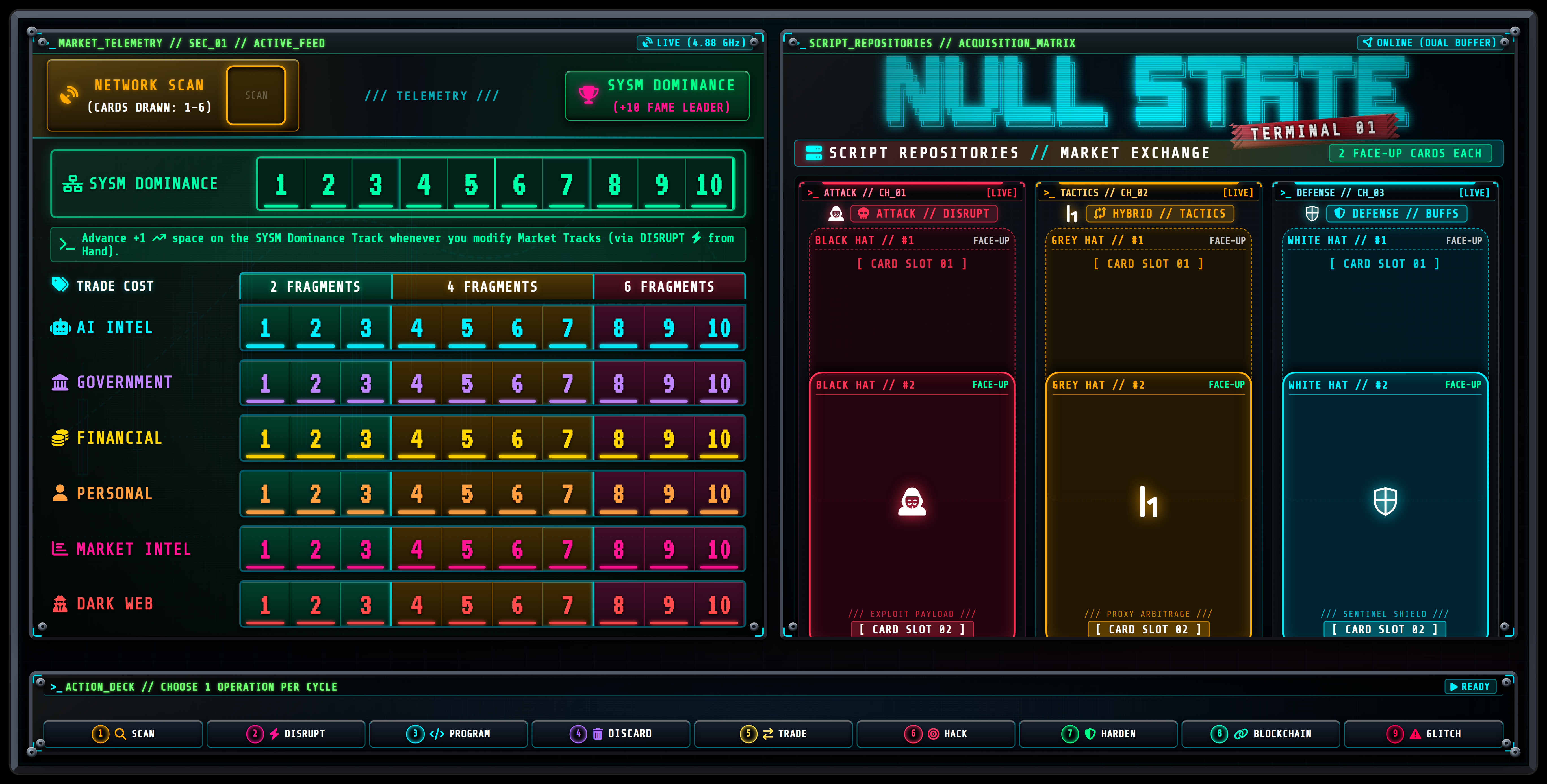
BOARD BAYS (SLOTS 1 & 2)
-
Network Scan Die
- Roll 1d6 for the Network Scan Die.
- Place the die directly on the gameboard on the Network Scan location showing the rolled value (1–6).
-
Starting Market Tracks & Difficulty Selection
- Players choose which starting value each of the six market tracks (AI Intel, Government, Financial, Personal, Market Intel, Dark Web) begins on based on desired thematic difficulty:
Difficulty Mode Track Range Starting Market Tier Trade Script Cost Description Safe Mode (Low Difficulty) 1–3 Depressed Tier 2 Scripts Beginner friendly; low market volatility and cheap upgrades. Surging Grid (Medium Difficulty) 1–7 Depressed to Surging 2–4 Scripts Standard tactical balance with escalating market pressure. Max Chaos (High Difficulty) 1–10 Full Market Spectrum 2–6 Scripts Cutthroat economic warfare across the full pricing curve. (Players may negotiate initial values or roll dice within the chosen difficulty range).
- SYSM Dominance Track: Each player places a marker at position 1. -
Location Grid & Player Setup Scaling
Parameter / Component 1–2 Players 3–4 Players Notes & Constraints Location Grid Deck 3 Location Cards 6 Location Cards Reveal 1 location initially; +1 revealed each round Control Cube Cap 6 Cubes max 9 Cubes max Active in-play limit per player Starting Data Hand 5 Cards 5 Cards Dealt from main Data Deck Hand Size Limit 7 Cards 7 Cards Excess triggers immediate Data Purge Memory Stacks 3 Active Stacks 3 Active Stacks Max 7 cards per stack Blockchain Asset Cap 20 Cards max 20 Cards max Permanent end-game scoring cards -
Operator Identity Cards
- Shuffle the Player Identity cards.
- Deal 1 card face up to each player. This provides your alias, backstory, and once-per-game Special Power.
-
Control Cubes Pool
- Each player takes control cubes of their chosen color up to their active limit (6 cubes for 1–2P, 9 cubes for 3–4P).
-
Starting Hand & Boot-Up Program
- Deal 5 Data cards to each player as their starting hand.
- Place 1 free Data card from the supply into one of each player’s 3 memory Stacks (face up). Each stack holds a maximum of 7 cards.
-
Ready Terminal Status
- Designate the first player randomly. Play begins with Player 1 and proceeds clockwise around the table.
Player cards and special powers
Each player operates an asymmetric Player Identity Console (alias, backstory, and a Special Power). Your special power breaks or bends one normal rule for you only and can be activated once per game.
| Operator Alias | Tactical Persona & Lore | Once-Per-Game Special Power |
|---|---|---|
h4x0r_99 |
Decoded encrypted server logs inside taxidermy mounts. Learned to read raw terminals. | Stack Hijack (Hack): Hack a location using another player's active Memory Stack instead of your own. They keep their physical cards, but you utilize their stack's suit and fragments. |
grep_grep |
Fallout shelter librarian who hoarded copper wire and retrofitted terminal monitors. | Market Swap (Disrupt): Completely swap the positions (values 1–10) of any two Market Tracks on the gameboard without discarding any cards. |
stack_smash |
Pre-collapse pigeon racer harnessing radio telemetry to map fiber optic junctions. | Deep Buffer (Scan): Look at top 10 cards of the Data Deck. Keep 3 in hand (ignoring die value) and place remaining 7 back on top of deck in any chosen order. |
Frybyte |
Tech district cook by day, terminal warrior by night with copper mesh filters. | Parallel Compile (Program): Program up to 3 cards from your hand into 3 different Memory Stacks as a single turn action. |
J4C0B |
Youngest hacker in District 01, turning security lockdown grids into child's play. | Triple Sweep (Trade): Claim the face-up market card from all 3 Hat Decks (Black, Grey, White) in a single action, paying only the single highest market cost. |
null_forgery |
Retired arcade technician who kept machines running through blackouts. | Global Fortify (Harden): Place 1 control cube on every location where you currently have at least one cube, without discarding any data cards. |
Hand limit (Data Purge)
Your maximum hand size is 7 data cards. If at any time you have more than 7 data cards in hand (e.g. after Scan, after drawing a Hack reward, or from any card effect), you must discard down to 7 immediately. This represents a Data Purge.
Turn order
Players take turns in order (Player 1, 2, …). On your turn you may perform one of the following actions:
On your turn — available actions
Players take turns in clockwise order (Player 1, 2, 3, 4). On your turn, you must perform exactly one of the following 9 tactical actions:
-
Scan (Network Draw)
- Draw data cards from the main draw deck equal to the current face value shown on the Network Scan Die (1–6).
- Data Purge: If this draw causes you to exceed 7 data cards in hand, you must immediately discard down to 7.
-
Disrupt (Market & Die Shift)
- Play data cards from hand and spend their printed Scripts to adjust economic indicators:
- Shift any of the 6 Market Tracks (1–10) up or down — 1 step per spent Script.
- Rotate/adjust the Network Scan Die (1–6) up or down — 1 step per spent Script.
- SYSM Dominance Progression: Each time you alter market tracks through Disrupt, advance your player marker +1 space on the SYSM Dominance Track.
- Discard all played cards after adjusting.
- Play data cards from hand and spend their printed Scripts to adjust economic indicators:
-
Program (Memory Assembly)
- Compile executable scripts into your memory hardware:
- Play 1 data card from your hand face up into one of your 3 Memory Stacks (each stack holds max 7 cards).
- OR replace a card already sitting in an active stack (send the replaced card to the discard pile).
- Compile executable scripts into your memory hardware:
-
Discard Stack (Cache Reset)
- Flush a compromised, outdated, or misconfigured memory stack. Discard all cards from one of your active Stacks to the data discard pile to open a clean stack slot for new operations. (Consumes your entire turn action).
-
Trade (Market Acquisition)
- Purchase 1 of the 2 face-up market cards OR choose to draw the top face-down card blind from any of the three Market Decks (Black Hat, Grey Hat, White Hat). The cost in Scripts from hand is set dynamically by its driving Market Track:
Hat Market Bay Driving Sector Tracks Depressed Tier (1–3) Surging Tier (4–7) Peak Tier (8–10) Black Hat (Attack // Disrupt) Dark Web & Government 2 Scripts 4 Scripts 6 Scripts Grey Hat (Hybrid // Tactics) Market Intel & Personal 2 Scripts 4 Scripts 6 Scripts White Hat (Defense // Protocols) AI Intel & Financial 2 Scripts 4 Scripts 6 Scripts - Type Matching Rule: All data cards played to pay the Trade Script cost must all be of the same data type (e.g. all Government, all Market Intel, all Financial, all Personal, all AI Intel, or all Dark Web).
- If a face-up card was taken, immediately flip a replacement card face up from that deck so 2 cards remain visible. Discard excess if hand exceeds 7 (Data Purge).
-
Hack (Node Infiltration)
- Infiltrate a revealed target location by playing one completed Stack from your console:
- Prerequisite: You must have available control cubes in your pool (under your active limit: max 6 for 1–2P, 9 for 3–4P).
- Requirement: Your Stack's total Scripts must meet the location's printed requirements, plus +1 extra matching Script per rival control cube already present on the card.
- Execution & Rewards:
- Place 1 control cube on an open reward spot (or next to the card if all spots are filled) and claim that spot's printed reward.
- Full Control: If you currently have strictly more control cubes on the location than any other rival, you hold Full Control and claim the location's printed Fame.
- Discard the executed Stack to the data discard pile after resolving.
- Infiltrate a revealed target location by playing one completed Stack from your console:
-
Harden (Security Fortification)
- Fortify your security foothold on a location where you already have at least 1 control cube:
- Discard 1 data card matching each of the location's required data types directly from an active Stack.
- Place +1 additional control cube onto the location to cement Full Control or defend against rival takeovers.
- Fortify your security foothold on a location where you already have at least 1 control cube:
-
Blockchain (Asset Commitment)
- Commit proprietary data onto the immutable public ledger for end-game scoring:
- Place 1 data card from your hand face up into your public Blockchain Pile (max 20 cards).
- These cards remain permanently locked and will multiply your end-game score based on final Market Track tiers (2 / 4 / 6 points per 10 SYSM).
- Commit proprietary data onto the immutable public ledger for end-game scoring:
-
Deploy Glitch (Agents of Chaos)
- Unleash a volatile corrupted data payload from your hand:
- Play 1 Corrupted Data Card from your hand and immediately resolve its printed
CHAOSeffect (symmetrical glitches affecting all players, wiping stacks, resetting market tracks, or disabling hardware). - Discard the corrupted card to the data discard pile after resolution. (Consumes your entire turn action).
- Play 1 Corrupted Data Card from your hand and immediately resolve its printed
- Unleash a volatile corrupted data payload from your hand:
Corrupted Data Cards (Pioneer Edition & Booster Expansions)
[PIONEER EDITION INCLUSION]: The physical Pioneer Edition base game box comes pre-packaged with 18 Corrupted Cards (Pack 01: Protocol Fracture) included alongside the 110 functional data script cards (128 Data Cards total). Players can play with them out of the box for high-stakes emergent chaos, or easily set them aside for a pure Clean Protocol (110 pure data cards, 0 corrupted cards) tournament experience.
Booster Pack 02 (Zero-Day Outbreak) is available separately as an 18-card expansion pack to add high-tier malware and AI anomalies or swap cards into your core deck.
Corrupted Data Cards represent defective sector blocks, physical cable cuts, liquid hardware catastrophes, and zero-day malware shuffled into the Data Deck to inject high-volatility chaos into the network economy.
1. In Hand & Limitations
- 0 SYSM Value: Corrupted cards provide 0 SYSM and cannot be stored in your Blockchain pile.
- 0 Fragment Scripts: They cannot be used as input fragments in a Hack, cannot pay for Trade costs, and cannot be discarded for a Disrupt action.
- Hand Limit: They count against your 7-card Hand Limit. During a Data Purge, you may discard them freely.
2. How to Play: Action 9 — Deploy Glitch
On your turn, you may spend your action to Deploy Glitch:
1. Choose one Corrupted Data Card from your hand.
2. Read and resolve the printed CHAOS effect immediately. These are symmetrical, double-edged glitches that disrupt all players, crash/surge the global market tracks, clear active Stacks, or randomize dice.
3. Place the Corrupted Data Card into the general data discard pile.
Strategic Note: Because Corrupted Cards provide 0 SYSM and affect everyone at the table (including yourself), deploying a glitch is a high-stakes tactical gambit to break a stalemate, reset surging market tracks, or wipe out an opponent's dangerous Hack stack.
3. Example Corrupted Data Cards
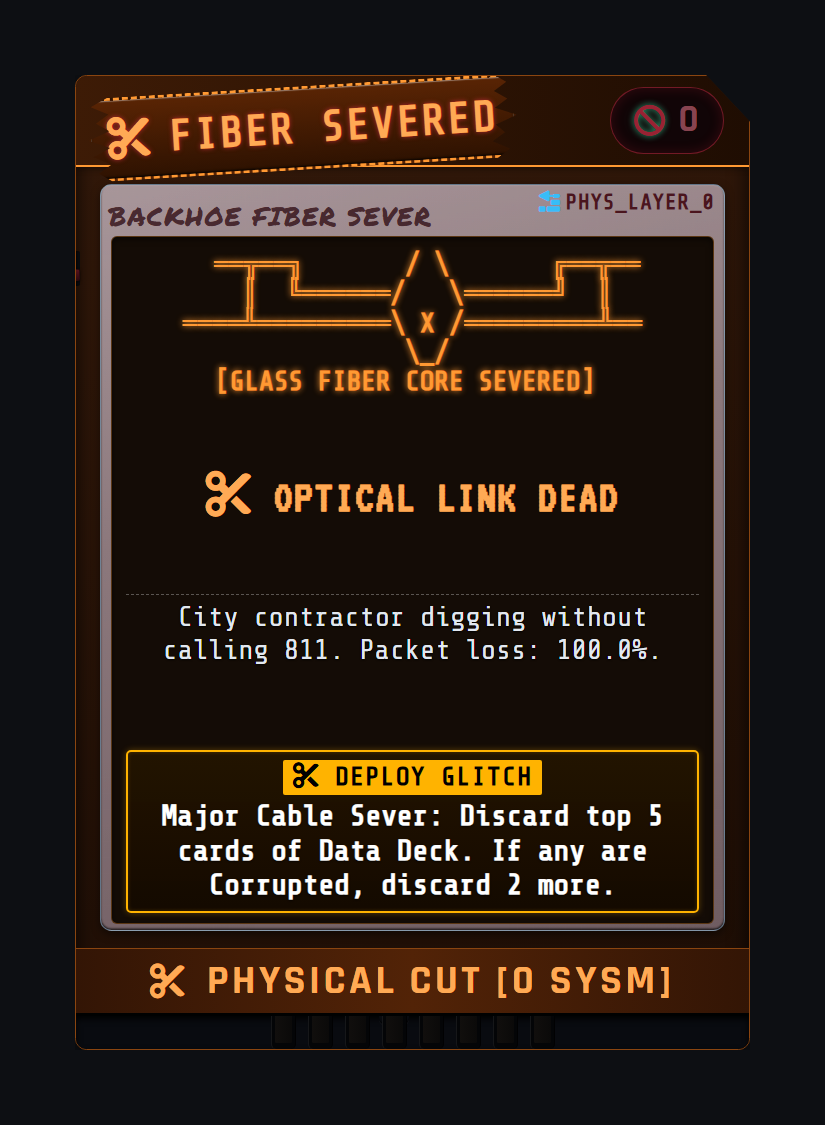 OPTICAL LINK DEAD
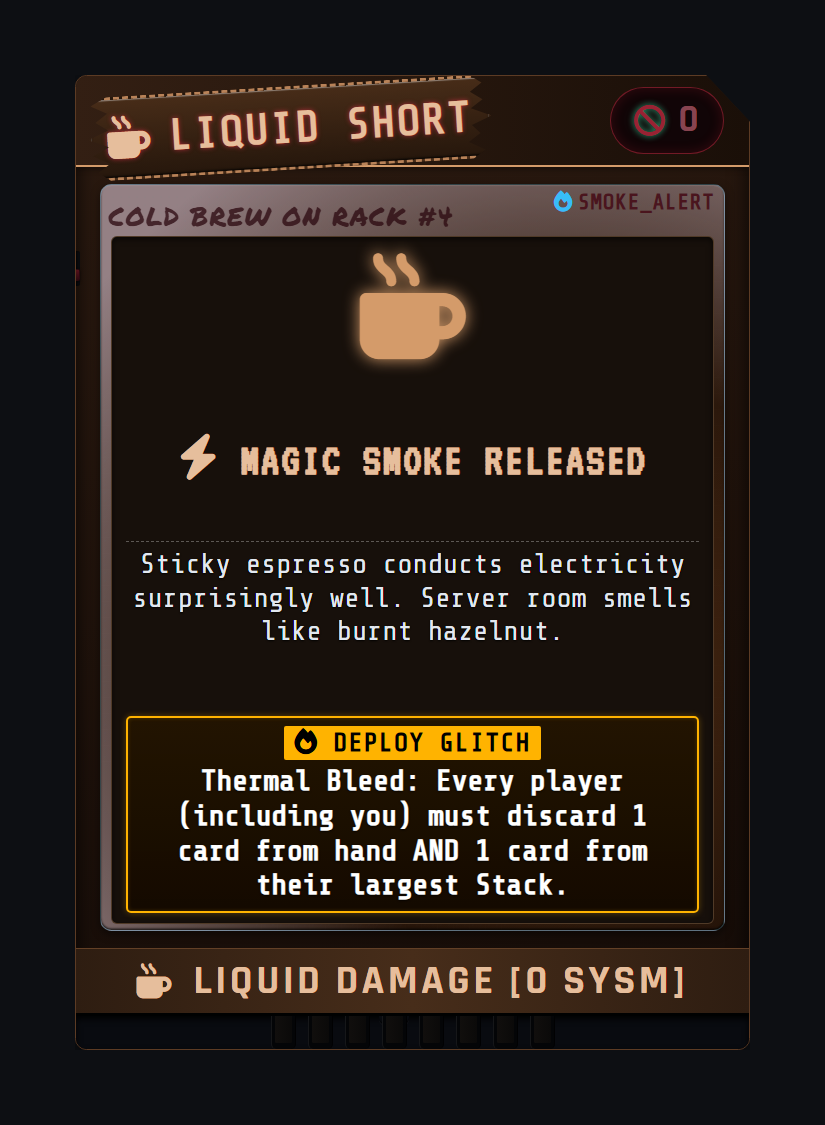 RJ45 DISLODGED
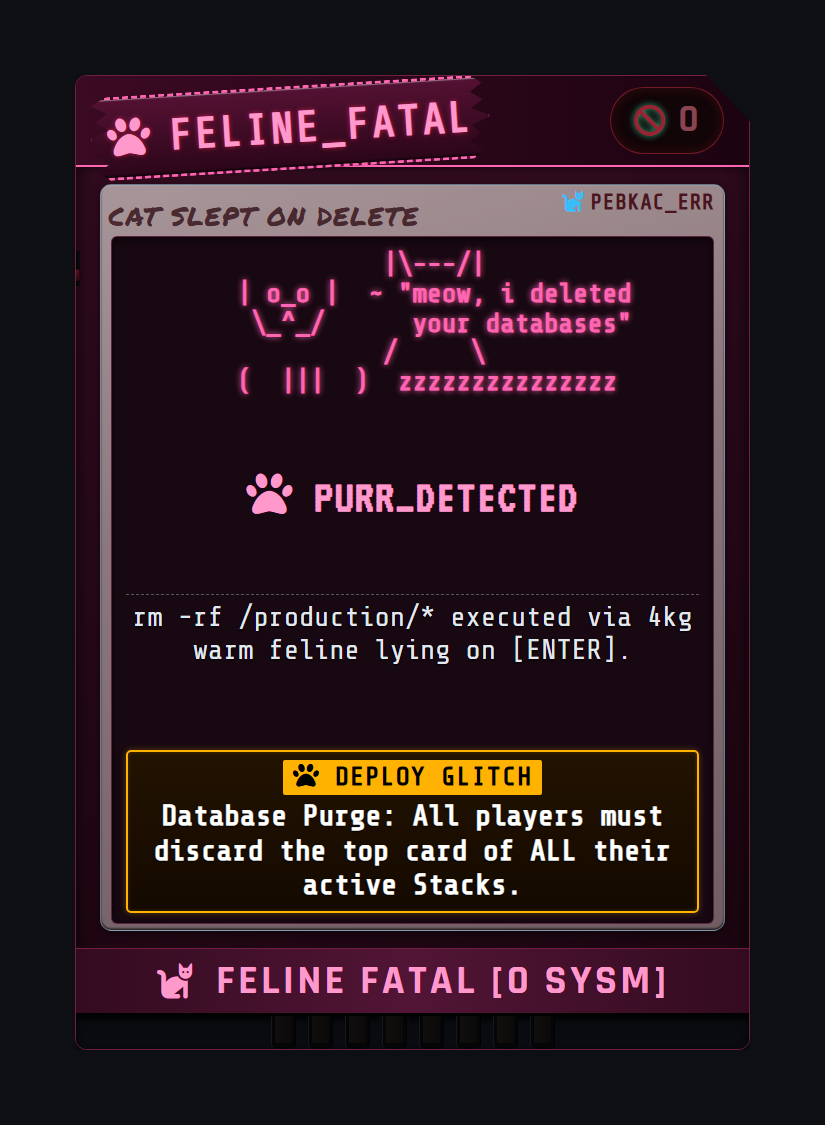 FELINE FATAL
4. Modular Booster Pack Setup
Players can tune the network's volatility and chaos level during setup by choosing which Corrupted Data Card profile to shuffle into the 110-card functional Data Deck:
| Network Profile | Added Corrupted | Total Deck Size | Volatility | Gameplay Experience & Focus |
|---|---|---|---|---|
| Clean Protocol | 0 Cards |
110 Cards | Low |
Standard competitive cyber warfare. Pure algorithmic efficiency and deterministic stack building with zero random hardware glitches. |
| Subtle Static | 6–8 Cards |
~117 Cards | Moderate |
Occasional defective sector or minor line noise without completely derailing long-term memory stacks. |
| Protocol Fracture (Pioneer Base Box) | 18 Cards (Pack 01) |
128 Cards | High |
Physical layer cuts, HVAC floods, hardware meltdowns, and git merge disasters. Pre-packaged inside the Pioneer Edition box! |
| Zero-Day Outbreak (Expansion) | 18 Cards (Pack 02) |
128 Cards | High |
High-tier ransomware locks, AI hallucinations, memory leaks, fork bombs, cosmic ray bitflips, and logic exploits. |
| Total Mayhem (Packs 01 & 02) | 36 Cards (P1 + P2) |
146 Cards | Extreme |
Total catastrophic system collapse. High economic volatility, frequent table-wide stack wipes, and rapid market resets. |
Quick Setup Procedure:
1. Retrieve the 110 functional Data Cards (the core operational card pool).
2. Select your preferred Corrupted Card profile from the matrix above (e.g. all 18 Pack 01 cards for the Pioneer Edition default experience).
3. Riffle shuffle both sets together thoroughly to form the unified Data Deck.
4. Deal 5 starting cards to each operator's hand (Hand Limit: 7). Place the remaining deck in the center data staging bay.
Board reference & Dynamic Markets
Markets (Dynamic Economy & Multipliers 1–10)
The 6 economic market tracks govern real-time trade costs and end-game crypto multiplier payouts:
| Sector Track | Sector Theme | Associated Hat Market Bay | End-Game Scoring Multiplier |
|---|---|---|---|
| AI Intel | Neural networks & synthetic models | White Hat (Defense / Protocols) | 2 / 4 / 6 pts per 10 SYSM |
| Government | Municipal infrastructure & defense logs | Black Hat (Attack / Disrupt) | 2 / 4 / 6 pts per 10 SYSM |
| Financial | Banking transaction ledgers & crypto vaults | White Hat (Defense / Protocols) | 2 / 4 / 6 pts per 10 SYSM |
| Personal | Identity dossiers & private communications | Grey Hat (Hybrid / Tactics) | 2 / 4 / 6 pts per 10 SYSM |
| Market Intel | High-frequency telemetry & corporate leaks | Grey Hat (Hybrid / Tactics) | 2 / 4 / 6 pts per 10 SYSM |
| Dark Web | Black-market exploits & shadow relays | Black Hat (Attack / Disrupt) | 2 / 4 / 6 pts per 10 SYSM |
System Constraints & Board Elements
| Board Element / Asset | In-Play Hard Limit | Tactical Rules & Mechanics |
|---|---|---|
| Network Scan Die | 1 Die (1–6) | Determines cards drawn during a Scan action. Adjusts via Disrupt (+1 step per Script). |
| SYSM Dominance Track | 1–10 Meter | Advances +1 space whenever you Disrupt markets. Farthest player earns +10 pts at game end. |
| Control Cubes | 6 (1–2P) // 9 (3–4P) | Placed on target locations during Hacks or Hardening. Majority holds Full Control & Fame. |
| Hand Capacity | 7 Data Cards | Strict limit across all turns. Exceeding 7 triggers an immediate Data Purge. |
| Memory Stacks | 3 Active Stacks | Max 7 cards per stack. Used as executable script payloads for Hacking nodes. |
| Blockchain Storage | 20 Banked Cards | Permanently locked data cards converted into victory points at match conclusion. |
End of game — victory and conditions
End game trigger
The final round begins when all locations for your player count are revealed and each has been Hacked at least once. Complete the current round so all players have equal turns.
Victory Scoring
The player with the highest total score wins:
Final Score = Location Fame + Blockchain Market Multipliers + SYSM Dominance Bonus
| Scoring Category | Calculation Method | Scoring Rate / Value |
|---|---|---|
| Location Control Fame | Total printed Fame from all controlled nodes | Requires strict majority of cubes |
| Blockchain Assets | (Total Sector SYSM ÷ 10) × Final Tier Multiplier | 2 pts (Tier 1–3) // 4 pts (Tier 4–7) // 6 pts (Tier 8–10) |
| SYSM Dominance Leader | Farthest along the SYSM Dominance Track | +10 Points flat bonus |
End-Game Scoring Example
At game end, Alice calculates her final score:
- Fame from Controlled Locations: 14 Fame
- Blockchain Market Multipliers:
- Market Intel (Track at 8 = Tier 8–10, 6 pts / 10 SYSM): 60 SYSM → 36 pts
- Dark Web (Track at 5 = Tier 4–7, 4 pts / 10 SYSM): 30 SYSM → 12 pts
- SYSM Dominance Leader Bonus: +10 pts
- Total Final Score: 14 + 36 + 12 + 10 = 72 Points
Zero Day Run (Short Game Variant)
For a fast-paced, high-intensity match (approx. 20–30 mins):
- Reduced Location Pool: Use 3 locations for 1–2 players, or 4 locations for 3–4 players.
- Accelerated Setup: Each player starts with 2 Data Cards pre-programmed into Stack 1 during setup.
- Tight Blockchain Cap: Maximum Blockchain capacity is reduced to 10 cards.
Quick Reference & Action Matrix
| Action | Operational Execution & Rules |
|---|---|
| 01 // Scan | Draw data cards from main deck equal to active Network Scan Die Slot value (1–6). Discard overflow down to 7-card hand limit immediately (Data Purge). |
| 02 // Disrupt | Play matching data cards from hand to move any Market Track (1–10) or the Network Scan die (1–6) up or down by 1 step per spent Script. Advance +1 space on the SYSM Dominance Track. |
| 03 // Program | Load 1 data card from hand into one of your 3 memory stacks (max 7 cards per stack), or swap 1 card in an existing stack. |
| 04 // Discard Stack | Flush an entire memory stack to the data discard pile to clear register space for new payloads (consumes your action). |
| 05 // Trade | Purchase 1 of the 2 face-up cards (or top card blind) from any Hat Market Deck (Black, Grey, White). Pay the current Market Track Tier cost in Scripts (2 / 4 / 6 Scripts; all payment cards must match the single sector type of the chosen track). Immediately flip a replacement card face up. |
| 06 // Hack | Infiltrate an active target location using a programmed Memory Stack. Must meet or exceed printed required Scripts + rival control cubes. Place 1 control cube, claim instant spot rewards. |
| 07 // Harden | Fortify a location where you already have presence. Discard required sector types from a stack to place 1 additional control cube. |
| 08 // Blockchain | Permanently bank 1 data card face up from hand into your Blockchain pile (max 20 cards) for end-game crypto multiplier scoring. |
| 09 // Deploy Glitch | Play 1 Corrupted Data Card from hand to trigger its printed symmetrical CHAOS event immediately. Place into data discard pile. |
System Constraints & Hard Limits
- Hand Limit: Strictly 7 data cards max across all phases (excess triggers immediate Data Purge).
- Memory Stacks: Maximum 3 memory stacks, holding up to 7 programmed data cards each.
- Blockchain Cap: Maximum 20 banked data cards in your public ledger for end-game scoring.
- Control Cubes: Maximum 6 cubes (1–2 players) or 9 cubes (3–4 players) active across all target locations.
Market Track Economics
| Market Tier | Track Range | Hat Trade Cost | End-Game Score Rate |
|---|---|---|---|
| Tier 1: Depressed | Steps 1 – 3 | 2 Scripts |
2 pts per 10 SYSM |
| Tier 2: Surging | Steps 4 – 7 | 4 Scripts |
4 pts per 10 SYSM |
| Tier 3: Peak | Steps 8 – 10 | 6 Scripts |
6 pts per 10 SYSM |
Player interaction (Table Talk, Deals, and Favors)
As hackers competing across the digital underground, player negotiation is an active part of the game.
Table Talk, Deals, and Favors
Players may talk, negotiate, and offer or accept deals or favors at any time, including during another player's turn. Deals can involve data cards, market cards, or promises (for example: "do not Hack that location and I will leave that market card for you"). If a deal involving cards is accepted, the exchange happens immediately and does not use an action. The standard hand limit applies after any card exchange. Promises about future actions are non-binding by rule and rely entirely on table trust. (In addition to the standard Trade action with the market, this allows open player-to-player card trades anytime by mutual agreement.) Alliances and truces are similarly non-binding agreements between operators.
Optional Variant: Gentleman's Agreement
If your table wishes to formalize alliances, you may mutually agree before the match to use the Gentleman's Agreement:
- When you Hack a location where an ally holds full control, you may not claim the Fame for that Hack (you still place your control cube and claim the spot reward). This prevents immediate betrayal for Fame while still permitting competitive infiltration.
Credits & Acknowledgments
- Game Design & Architecture: Ov3rlrd Aka Daniel M Simser
- Additional System Design: Ov3rlrd Aka Daniel M Simser
- Playtesters: Sarah Simser, Grace Simser, Theodore Simser, Jacob Simser, Della Sebring (for the chaos she brought)
- Production & Publishing: Fuzzy Robotics LLC // Null State: Terminal 01
(For Solo AI rules against automated syndicate rivals, refer toSOLO_RULES.md)
System Patch Notes
BUILD v2.0-ZERO_DAY // PROTOCOL OVERCLOCK // ZERO-DAY RUNTIME
- SYS.KERNEL // STRICT TURN CONCURRENCY: Enforced strict '1 ACTION PER TURN' rule across all terminal specifications, system docs, and player reference aids. Multi-action stack chaining exploits have been deprecated to maintain deterministic turn pacing.
- OP.ROSTER // EXPLOIT PRODIGY DEPLOYED [J4C0B]: Added District 01's youngest hacker alias 'J4C0B' ([ROLE // EXPLOIT PRODIGY]) with overclocked cyan lightning telemetry HUD. Unique exploit allows claiming face-up cards across Black, Grey, and White Hat market decks in a single Trade execution.
- TACTICAL.OPS // ACTION 09 'DEPLOY GLITCH': Added Action 09 to the Tactical Operations array. Operators can now deploy Corrupted Data Cards directly from hand to trigger printed CHAOS payloads (network crashes, buffer dumps, and optical fiber severs) before discarding.
- CORRUPT.EXP // 36 ZERO-DAY OUTBREAK CARDS: Curated and rendered 36 Corrupted Glitch cards across Pack 01 (Protocol Fracture: physical cut & hardware faults) and Pack 02 (Zero-Day Outbreak: fork bombs, AI hallucinations, memory leaks, and logic exploits).
- LEDGER.VAL // BLOCKCHAIN SCORING MULTIPLIERS (2, 4, 6): Synchronized end-game Blockchain scoring multipliers with Market Cost Tiers (Tier 1–3 = 2 pts / 10 SYSM, Tier 4–7 = 4 pts / 10 SYSM, Tier 8–10 = 6 pts / 10 SYSM). Purged legacy crypto die formulas.
- HUD.OPT // REFERENCE AID WHITESPACE REBALANCING: Stripped the redundant hardware limits box from player reference aids to maximize optical whitespace and scale action typography to 300 DPI high-contrast print readability.
- RENDER.VEC // AUTOMATED LANDSCAPE NORMALIZATION: Re-aligned all 5.5" x 3.5" Jumbo cards (District 01 Locations, Off-Grid Anomalies, Operator Cards, and Reference Aids) to 1725x1125 px horizontal viewing planes for browser previews.
- CREW.LOGS // PLAYTESTER TELEMETRY & DELLA SEBRING CHAOS LOG: Integrated playtester telemetry into the core system credits, giving special recognition to Della Sebring for the glorious chaos injected into active playtests and uncovering volatile edge-case exploits.
- MARKET.SEC // TRADE SECTOR MATCHING PROTOCOL: Market Trade actions require all turned-in cards to match the target Market Track's single data type (Tier 1–3 = 2 Scripts, Tier 4–7 = 4 Scripts, Tier 8–10 = 6 Scripts).
- AUTOMA.AI // SYNDICATE NET SOLO EXPANSION: Added official rules supplement for solo play against 1, 2, or 3 automated AI rivals (Ghost_Root, Satoshi_V, Vortex_Net, Cipher_Phreak, NetSec_Unit_09, Nexus_Overlord) with zero manual hand-tracking.
- SYS.DOMINANCE // TRACK DISRUPT ADVANCEMENT: Disrupt action allows shifting Market Tracks or Scan Die +-1 per card, advancing the operator on the SYSM Dominance Track for the +10 Leader Bonus.
- HARDWARE.SPEC // COMPONENT ALLOCATION: Base game box includes 128 Data Cards (110 Data + 18 Corrupted), 24 Location Targets, 72 Market Cards (Black, Grey, White Hat), 6 Operator Dossiers, 6 Player Reference Aids, 1 Custom D6 Scan Die, and Player Control Cubes.
Production & Credits
System Deployment: Null State: Terminal 01
Open Source & License Attributions
Typography & Fonts: JetBrains Mono (SIL Open Font License 1.1), Press Start 2P (SIL Open Font License 1.1), Share Tech Mono (SIL Open Font License 1.1), VT323 (SIL Open Font License 1.1), Inter (SIL Open Font License 1.1)
Icons & Graphics: Font Awesome Free (CC BY 4.0 (Icons), SIL OFL 1.1 (Fonts), MIT (Code))
Open Source Engine: Null State™ Core System Rules & Deck Engine (Open Source Tabletop License / CC BY-SA 4.0)
© Fuzzy Robotics LLC